The Rich Ruler (A Man Who Could Not Give)
Posted: January 23, 2020 Filed under: The Eucharist and Living the Eucharist Leave a commentWe read of a wealthy ruler’s encounter with Christ in St. Luke’s gospel. He begins a conversation with him by his question, “What shall I do that I might inherit eternal like?” By their dialogue we learn that he kept all the rules. However, Jesus moves deeper: “Yet, there is one thing you still lack. Sell everything you have, and give to the poor, then you will have treasure in heaven, then come, follow me” (18:22)
This wealthy man had to give. But, he had to give from the core of his being. His whole identity was in his wealth. He was defined by his wealth. His wealth sheltered him, clothed him well, fed him well. By it he was able to move through life with status, privilege, ease, and comfort. But the cost was too dear.
We are asked to give — usually not to the same extent — but we are to give. We can write a check, contribute on-line, or drop some cash in a box. Quite easy, and we don’t break a sweat. But, as was the wealthy ruler, we are sometimes asked to give from a deeper place, a costlier place. What might this mean? Let’s look to Jesus for the answer. He gave himself, he emptied himself — all done that he could receive us to himself in relational union with him, the Father, and the Holy Spirit.
What prevents us from giving in this manner? Self preservation. I refer to Jesus’ words found earlier in St. Luke’s gospel: “For whoever would save his life will lose it; and whoever loses his life for my sake, he will save it” (St. Luke 9: 24). It seems then, that ultimately we must give from that place we keep locked up tight and secure for our self preservation. It is from this vault that we need to reach into when called upon from time to time.
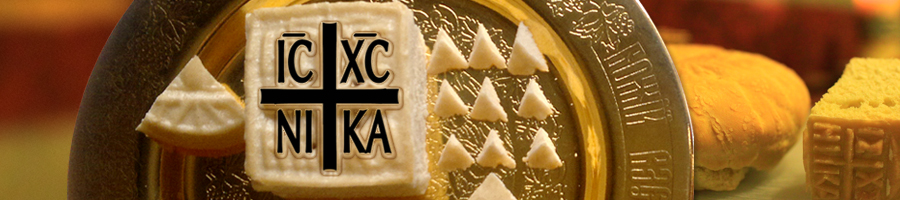
Again remember our Lord: he was self-giving, and other-receiving. This transaction of self is eucharistic. In the Eucharist, Christ gives himself anew to us via the bread which becomes his Body and the wine which becomes his Blood. In the Eucharist we have Christ welcoming us to himself as we move to his Banquet Table. We, by consuming his Body and Blood, have Christ entering into our being, and we are joined more fully to Christ. Thus, when we give of ourselves to and for others, and we receive others to ourselves, we extend to Eucharist to all and all things. Ultimately by this type of giving we receive Christ more fully into our lives.
I am reminded of the words of St. Francis: “It is in giving that we receive…” The wealthy man, had he given, would have received far more in return than that which he had to give up. He would have received Christ in return. Let us give eucharistically that we may gain Christ more fully.
In Christ,
Fr. Irenaeus
The Thankful Leper
Posted: January 21, 2020 Filed under: The Eucharist and Living the Eucharist Leave a comment St. Luke’s gospel gives us the account of Jesus’ healing of ten lepers (17: 11 – 19). They stood at a distance as he passed by — they were unclean, excised from society by their disease from all relationships and cultural participation. They were exiles in their own land. Yet, by faith, they boldly call out for God’s mercy to come upon them. And Jesus responds to their plea: “Go and show yourselves to the priests.” St. Luke comments, “And as they went they were cleansed.” Their bodies were restored, and their stigma was washed away. They were restored to family, community, and communal worship.
All obeyed. They did precisely as they were told. Let me be clear, obedience to God’s command and will is always good! But, we should be honest with ourselves: sometimes it is minimal and superficial. It can be as a child’s response, “If I have to!”
As the text moves on we read,
Then one of them, when he saw that he was healed, turned back, praising God with a loud voice; and he fell on his face at Jesus’ feet, giving him thanks. Now, he was a Samaritan (17: 15 – 16).
The tenth, now healed, leper awakens to his salvation, and he responds to his healing with praise, worship, and thanks. This foreign leper responded to Jesus eucharisticallly. Jesus observes the contrast and remarks,
…Were not ten cleansed? Where are the nine? Was no one found to return and give praise to God except this foreigner? And he said to him, Rise and go your way; your faith has made you well (17:17 – 19).
Let’s consider obedience and duty in the context, first, of the worship of God in the Divine Liturgy of the Orthodox Church. We have responded to the call to worship when we assemble within the walls of the church. This is good — neither did we sleep in on a Sunday morning, nor stay home to relax, or watch the game. This is good. But as stated above, sometimes our obedient assembly can be minimal and superficial. We need to be mindful that by our presence in the Divine Liturgy we’ve assembled to worship and praise the Triune God, and to give thanks to our God. We read this dialogue between priest and the faithful from the beginning of the Anaphora of the Divine Liturgy:
Priest: Let us lift up our hearts.
People: We lift them up to the Lord.
Priest: Let us give thanks to the Lord.
People: It is proper and right.
The priest then continues,
It is proper and right to hymn You, to bless You, to give thanks to You, and to worship You in every place of Your dominion; for You are God ineffable, beyond comprehension, invisible, beyond understanding, existing forever and always the same; You and Your only begotten Son and Your Holy Spirit. You brought us into being out of nothing, and when we fell You raised us up again. You did not cease doing everything until You led us Your kingdom which is to come. For all these things we thank You and Your only begotten Son and Your Holy Spirit; for all things that we know and do not know, for blessings seen and unseen that you have bestowed upon us. We also thank You for this liturgy which You are pleased to accept from our hands…
From this we learn that we are to give thanks to God not only during our assembly for worship, but also “…in every place of your dominion.” Now, in this second context, we are to give thanks to God everywhere, at all times, and in all circumstances in which we find ourselves. St. Paul instructs us from his first letter to the faithful in first century Thessalonica: “Rejoice always, pray constantly, and give thanks in all things; for this is the will of God for you in Christ Jesus” (1Thes 5: 16 – 18). By this attitude and these actions we extend our worship of God from the context of the Divine Liturgy to the context of our every day lives. We are to rejoice, pray, and give thanks to God in every situation: the pleasant and the uncomfortable; the exciting and the mundane; the happy and the sad; in ease and in frustration.
By living doing so we live eucharistically. By doing so we are transformed more fully into the image of God — Christ is form fully formed in us. By doing so we manifest Christ into the circumstance and transform it. By doing so we live as the thankful tenth leper.
In Christ,
Fr. Irenaeus
 Father Irenaeus Williams