Christus Victor — A Primer (Part Two)
Posted: July 30, 2017 Filed under: The Eucharist and Living the Eucharist | Tags: Christ as the New Adam reverses the disobedience and capitulation of Adam, Christus Victor as model of atonement, Gabriel's appearance in the Annunciation reverses the deceit of the serpent, Jesus is the New Adam, Mary as New Eve, Mary's obedience undoes Eve's disobedience, Primer for Christus Victor model of salvation Leave a commentA REVERSAL OF MISFORTUNES (STEP BY STEP)

Icon of the Annunciation
STEP ONE: We must have a different spiritual being who approaches the woman — one who is holy and truthful. The following New Testament passages come from St. Luke’s Gospel:
And in the sixth month the angel Gabriel was sent by God to a city of Galilee by the name of Nazareth towards a virgin having been betrothed to a man by the name of Joseph from the House of David, and the name of the virgin was Mary. And upon approaching her he said, “Greetings, one-having-been-graced, the Lord is with you (Luke 1: 26 – 28).
Gabriel, unlike the serpent of old, does not deceive. He clearly declares his message:
And the angel said to her, “Fear not, Mary, for you have found favor with God. And behold, for you shall conceive, and the Son born of you will name Jesus. He shall be great and be called the Son of the Most High and the Lord God shall give to him the throne of his father David. And he shall rule over the House of David forever and his Kingdom shall not end (Luke 1: 30 – 33).
Christus Victor – A Primer (Part One)
Posted: July 24, 2017 Filed under: Etcetera, The Eucharist and Living the Eucharist | Tags: A primer for Christus Victor, Christus Victor as model of atonement, Christus Victor as model of salvation, Explanation of Christus Victor as model of salvation Leave a commentINTRODUCTION

Anselm of Canterbury
Cur Deus Homo? , or, “why did God become man?” This is the historic question asked by Anselm of Canterbury. In answering this question, he set forth the typical western, and has arguably become the dominant Protestant, view of salvation. By extension, his answer puts forward the typical (again dominant Protestant) view of salvation — substitutionary atonement. Here, God the Son became human to satisfy the Father’s just demand for satisfaction for humanity’s rebellion against his will. God the Father pours out his wrath against humanity on his Son — Jesus dies a horrid death and the Father is satisfied. From this humanity’s sin debt is paid by Christ, and we are in a legal right standing with God the Father — we have peace with God. To the Eastern Church, this is foreign, and somewhat repulsive. As a historic, and ancient, alternative the Eastern Church puts forth the model of salvation known as Christus Victor. A primer is set forth in the following postings.
Watership Down Character: Blackavar
Posted: July 12, 2017 Filed under: Speculative Fiction | Tags: Blackavar's conversion in Watership Down, significance of Blackavar in Watership Down, Watership Down character of Blackavar Leave a comment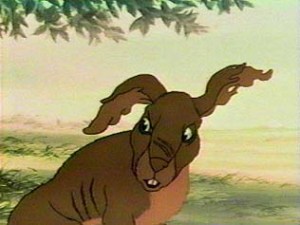
Blackavar
In Chapter 35 of Watership Down, “Groping,” Bigwig has infiltrated the Soviet-style Efrafan warren, and makes this observation of its inhabitants: “…never in his life had he seen such a cheerless, dispirited lot of rabbits.” Due to the oppressive rule of General Woundwort the warren was in decline, and Bigwig observes a disfigured rabbit. Adams gives this description:
This rabbit had very dark fur — almost black. But this was not the most remarkable thing about him. He was dreadfully mutilated. His ears were nothing but shapeless shreds, ragged at the edges, seamed with ill-knit scars and beaded here and there with lumps of proud, bare flesh. One eye-lid was misshapen and closed askew. Despite the cool, exciting air of the July evening, he seemed apathetic and torpid. He kept his gaze fixed on the ground and blinked continually. After a time he lowered his head and rubbed his nose on his forepaws in a listless manner. Then he scratched his neck and settled down in his former drooping position.
 Father Irenaeus Williams