Contra Islam: The Calling of Muhammad
Posted: April 23, 2026 Filed under: Contra Islam | Tags: did Muhammad encounter a demon in the Cave of Hira?, Lawrence Farley, the Archangel Gabriel and Joseph's dreams, the Archangel Gabriel and Mary during the Annunciation, The calling of Muhammad, the calling of Muhammad per al-Bukhari, the calling of the Old Testament prophets, the calling of the Prophet Jeremiah, the Cave of Hira, the Hadith of al-Bukhari Leave a commentMy critical examination of Islam continues with this posting. Though my words may be taken as confrontational, I bear no ill will for any Muslim. Rather, I pray they are drawn into the Light and Life of Jesus Christ who is God in human flesh, the God who forgives their sins by his death on the Cross, and gives them eternal life by means of his resurrection from the dead.
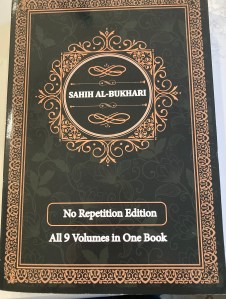 There is this question: How did the work of Muhammad and dictation of the Qur’an come to be? To answer this question, I have turned to Islam’s most trusted collection of the Hadith (collections of the stories about Muhammad): Sahih al-Bukhari. As a biographical note, Muhammad al-Bukhari was an imam, and was born in 810 AD (or 194 AH according to the Islamic dating system) in the city of Bukhara which is in present-day Uzbekistan. He was a devout student of Muhammad’s life via the growing hadith collections of his day. His own compilation, per Islamic tradition, occurred about 200 years after Muhammad’s death (632 AD). Yet, modern western scholars contest this timeline, since the work attributed to him did not have full circulation until the 14th century. Furthermore, the historicity of all the Hadith is more than a bit questionable.
Al-Bukhari provides the traditional overview of Muhammad’s inspiration:
Allah sent down his divine inspiration to his apostle continuously and abundantly during the period preceding his death till he took him unto him. That was the period of the greatest part of revelation, and Allah’s messenger…died after that (al-Bukhari, 1514).
By his collection he informs us how Muhammad began to receive the Qur’an. He provides details for his readers by quoting Aisha, his child bride (she was married to him at age six years, and their marriage was consummated when she was aged nine years!):
Al-Harith bin Hisham asked Allah’s messenger…”O Allah’s messenger! How is the divine inspiration revealed to you?” Allah’s messenger…replied, “Sometimes it is (revealed) like the ringing of a bell, this form of inspiration is the hardest of all and then this state passes off after I have grasped what is inspired. Sometimes the Angel comes in the form of a man and talks to me, and I grasp whatever he says” (al-Bukhari, 2).
She offers her recollection regarding Muhammad’s spiritual practice at the time of his calling:
The commencement of the divine inspiration to Allah’s messenger…was in the form of good dream which came true like bright daylight, and then the love of seclusion was bestowed upon him. He used to go in seclusion in the Cave of Hira where he used to worship (Allah alone) continuously for many days before his desire to see his family…(al-Bukhari, 3).
Given this, we learn that Muhammad piously worshipped the one he knew as Allah. In the same recollection, Aisha gives further information which includes the disturbing initial and fateful encounter with “The Angel”:
…The angel came to him and asked him to read. The prophet…replied, “I do not know how to read.” The prophet…added, “The angel caught me (forcefully) and pressed me so hard that I could not bear it anymore. He then released me and again asked me to read, and I replied, “I do not know how to read.” Thereupon he caught me again and pressed me a second time till I could not bear it anymore. He then released me and again asked me to read but again I replied, “I do not know how to read (or what shall I read)?” Thereupon he caught me for the third time and pressed me, and then released me and said, “Read in the name of your Lord, who has created (all that exists), created man from a clot. Read! And your Lord is the Most Generous [Qur’an 96: 1 – 3 is quoted]…(al-Bukhari, 3).
The hadith continues as it relates Muhammad’s intense distress caused by this encounter:
Then Allah’s messenger…returned with the inspiration and with his heart beating severely. Then he went to Khadija [his first wife]…and said, “Cover me! Cover me!” They covered him till his fear was over and after that he told her everything that had happened and said, “I fear that something may happen to me.” Khadija replied, “Never! By Allah, Allah will never disgrace you” (al-Bukhari, 3).
Khadija relates the encounter Muhammad had with the angel to her cousin, Waraqa. This man identifies “the Angel” to be Gabriel: “This is the one who keeps the secrets, the angel Gabriel whom Allah sent to Moses” (al-Bukhari, 3).
Here is the focus of this posting: Muhammad’s encounter with “Gabriel” is aggressive and confrontational. His experience is contrary to biblical encounters with the Archangel Gabriel, because this encounter frightened Muhammad. In his book Exploring Islam, A Christian Perspective on the Life of Muhamma and the Qur’an, Alhambra, California, Sebastian Press, 2022, Lawrence R Farley presents this information from another hadith:
He was in such agony of mind over the revelation that he became depressed and often wanted to throw himself from a cliff, and was only dissuaded when he heard the spirit say, “O Muhammad! You are Allah’s prophet” (p. 32).
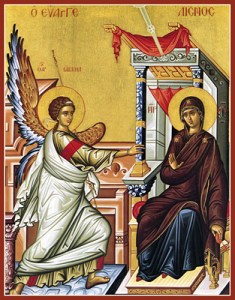
Icon of the Annunciation
Again, “the Angel’s” aggressive, disturbing encounter with Muhammad is the focus of this posting. This is important because this spiritual interaction is the complete opposite of the New Testament’s recording of human encounters with the Archangel Gabriel, and the calling of the major prophets of the Old Testament by God himself. The first contrast examined is the Archangel Gabriel’s interaction with St Mary during encounter called the Annunciation (which is celebrated every March 25).
In the sixth month the angel Gabriel was sent from God to a city of Galilee named Nazareth, to a virgin betrothed to a man whose name was Joseph, of the house of David; and the virgin’s name was Mary. And he came to her and said, “Greetings, you who have been graced, the Lord is with you [Χαῖρε, κεχαριτωμένη, ὁ κύριος μετὰ σοῦ]. But she was greatly troubled at the saying, and considered in her mind what sort of greeting this might be. And the angel said to her, “Do not be afraid, Mary, for you have found favor with God. And behold, you will conceive in your womb and bear a son, and you shall call his name Jesus (St Luke 1: 26 – 31).
Note that St Gabriel’s actions are courtly and respectful. Note also that he calms her fears with his words, “Do not be afraid, Mary.” There is no harsh or violent action directed to her that would cause intimidation or coercion. His actions were not only derivative of his nature, they were demanded because St Mary must willfully consent to becoming the Mother of God:
And Mary said, “Behold, I am the handmaid of the Lord; let it be to me according to your word.” And the angel departed from her (St Luke 1: 38).
We note the angel’s same peaceful interaction by means of a dream with St Joseph the Betrothed:
Now the birth of Jesus Christ took place in this way. When his mother Mary had been betrothed to Joseph, before they came together she was found to be with child of the Holy Spirit; and her husband Joseph, being a just man and unwilling to put her to shame, resolved to send her away quietly. But as he considered this, behold, an angel of the Lord appeared to him in a dream, saying, “Joseph, son of David, do not fear to take Mary for your wife, for that which is conceived in her is of the Holy Spirit; she will bear a son, and you shall call his name Jesus, for he will save his people from their sins” (St Matthew 1: 18 -21).
Again, note there was no intimidation or consequential fear that came about by the angel’s words. Then, about two years later, St Joseph had another dream visitation by the angel after the birth of Jesus. This, too, was a peaceful dream encounter, and is found in St Matthew 2: 13 – 15.
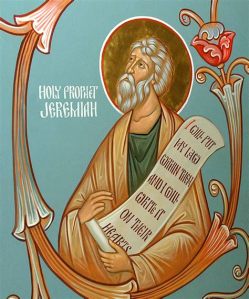 Also, in stark contrast to “Gabriel’s” demands placed upon Muhammad at his commissioning as a “prophet,” we can read of the commissioning of all the Old Testament prophets by God himself. All of them from the call of Samuel (1 Sam 3: 2 – 10) through the calling of all the minor prophets, we find no intimidation or coercion. Let’s examine the call of Jeremiah:
Now the word of the Lord came to me saying, “Before I formed you in the womb I knew you, and before you were born I consecrated you; I appointed you a prophet to the nations.” Then I said, “Ah, Lord God! Behold, I do not know how to speak, for I am only a youth.” But the Lord said to me, “Do not say, ‘I am only a youth’; for to all to whom I send you, you shall go, and whatever I command you, you shall speak. Be not afraid of them, for I am with you to deliver you, says the Lord.” Then the Lord put forth his hand and touched my mouth; and the Lord said to me, “Behold, I have put my words in your mouth” (Jeremiah 1: 4 – 9).
With Jeremiah’s commissioning we find promise and assurance, and there is no element of coercion or manipulation because God loves the man.
What, then, can be concluded? Given the hadith of al-Bukhari we learned that Muhammad was terrified by “the Angel”. We learned that Muhammad’s experience was the polar opposite of the experiences that came from the actions of the true Archangel Gabriel in the New Testament verses noted above, and the Lord God himself with the holy prophets of the Old Testament. I must ask, who was Muhammad worshipping in the Cave of Hira, and who posed as a commissioning angel in that cave? Accounts of demonic oppression, and even possession, generally violate the wills of those who are pressed to do their will. Based upon the interactions between humans and true, holy angels, and of the Lord himself, I must conclude that Muhammad worshipped (albeit unknowingly) a demon (some suggest Satan), and was commissioned violently by another demon posing as the holy Archangel Gabriel.
Violence begets violence. Coercion begets coercion. Fear begets fear. Lies beget lies. From this beginning we have Islam.
In Christ, who alone is the Way, the Truth, and the Life,
Fr Irenaeus
Contra Islam: The Seventh Century Antichrist
Posted: April 13, 2026 Filed under: Contra Islam | Tags: Apostolic Faith, Exodus 3: 14 and Jesus as God, I am the Existing One, Islam and Jesus, Islam is a religion of antichrist, Jesus declares himself to be God, John 8:58 and Jesus' self declaration to be God, Muhammad as antichrist, Quran 112: 1 - 4, Quran 112: 1 - 4 is anti Trinitarian, St John the Apostle, The Word in St John 1: 1 - 2 2 Comments
In the Qur’an Jesus (Isa in Arabic) is both acknowledged and given some degree of respect as a prophet, but only as a prophet who lived before Muhammad. Islam denies the core Christian knowledge and teaching of who Jesus is, and the salvation he gives to humanity. Islam denies Jesus’ deity and consubstantiality with the Father. Islam denies that Jesus is God in human flesh. Thus, I use the term antichrist. To understand Islam’s crucial error we must dive into what the Christian faith has always taught about Jesus. For this understanding, let’s turn to the fourth Gospel.
St John the Apostle, Evangelist, and Theologian is the only Apostle to use the word antichrist in the New Testament. In this posting I discuss how he uses this word, its meaning, and its application to the words of two of the Qur’an’s chapters (surah). These Qur’anic verses are a critical and core source of Islamic false teachings about the Person and nature of Jesus Christ:
Say: He is Allah, the one and only; Allah, the eternal, absolute; he begets not, nor is he begotten; and there is none like unto him (Qur’an 112: 1 – 4).
To him is due the primal origin of the heavens and the earth: How can he have a son when he has no consort? (Qur’an 6: 101a)
The Word Is God
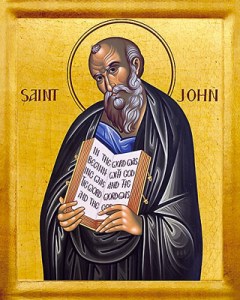 Initially, let’s examine the term theologian as it applies to St John. He is a theologian because he is first to articulate in written form the fact that Jesus is God. This brings us to the first chapter of his Gospel. The Greek text for St John 1: 1 – 2 is as follows:
Ἐν ἀρχῇ ἦν ὁ λόγος, καὶ ὁ λόγος ἦν πρos τoν θεόν, κα θεoς ἦν ὁ λόγος. οὗτος ἦν ἐν ἀρχῇ πρoς τoν θεόν.
(In the beginning was the Word, and the Word was with God, and the Word was God. This one was with God in the beginning.)
A bit of a grammatical deep dive is in order. In the above Greek text we find two uses of the word God: τoν θεόν (ton theon), which uses the definite article, τov (ton), and then θεoς (theos) which lacks the definite article (being anarticular). With the first usage, the definite article, τoν, is used to distinguish toν θεόν from the anarticular θεoς.
What is all of this about, and why is this important? While Greek uses definite articles, being “the” in English, the Greek language lacks an indefinite article, being “a” or “an” in English. Let’s look at this English example. Dolly is the dog. Using the definite article, this means Dolly is one particular dog. In English this sentence can be changed to Dolly is a dog. The use of the indefinite article “a” gives a different meaning: Dolly is one of an infinite number of dogs. In extension of this example, since there is no indefinite article in Greek, I must reword the sentence to Dolly is dog, meaning Dolly is an animal that possesses the quality of being dog. Thus, it would be incorrect to translate καὶ θεὸς ἦν ὁ λόγος as “and the Word was a god,” or one of many gods. The proper way to translate καὶ θεoς ἦν ὁ λόγος is, “and the Word was God.” With St John’s use of the anarticlular θεoς, this means ὁ λόγος (the Word) possesses the ontological quality of God, yet the Word is not τoν θεόν, the Father, the first Person of the Trinity.
St John is not done expressing further how the Word is God, and yet, is distinguished from the Father. He completes this theological distiction with this complementary verse: St John 1: 18,
θεoν οὐδεὶς ἑώρακεν πώποτε· μονογενὴς θεoς ὁ ὢν εἰς τoν κόλπον τοῦ πατρoς ἐκεῖνος ἐξηγήσατο.
(No one has ever seen God: God the Only Begotten who exists in the bosom of the Father made that one known.)
In this verse, St John further identifies the Word of verse one as the Only Begotten (Son) who knows the Father intimately, and makes the Father known to humanity. (I refer you to St John 12: 45 where Jesus says, “The one who perceives me, perceives the one who sent me.”)
The Word Became Flesh
St John continues orthodox and catholic Christology by declaring that the Word (Logos) took on human flesh to demonstrate, in the most compelling way possible, the loving heart of his Father:
Καὶ ὁ λόγος σὰρξ ἐγένετο καὶ ἐσκήνωσεν ἐν ἡμῖν, καὶ ἐθεασάμεθα τὴν δόξαν αὐτοῦ, δόξαν ὡς μονογενοῦς παρὰ πατρός, πλήρης χάριτος καὶ ἀληθείας· (St John 1: 14).
(And the Word became flesh and tabernacled with us, and we observed his glory, glory as the Only Begotten of the Father, full of grace and truth.)
Taken together, the Apostle has made two profound theological assertions. First, the one he calls both the Word and the Only Begotten (Son) is himself God, just as the Father is God. Also, from St John 1: 1 – 2, 18, we see that the Father and the Son have a relational union of being which parallels Jesus’ words in St John 10: 30, “ἐγὼ καὶ ὁ πατὴρ ἕν ἐσμεν (I and the Father are one).” Second, St John states that the second Person of the Trinity, the Word, the Only-begotten Son, took on human flesh.
Jesus Declares Himself to Be God
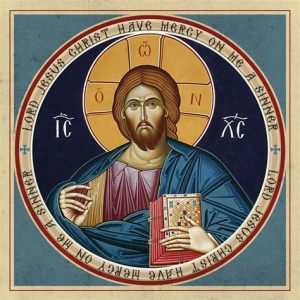 Elsewhere in his fourth Gospel, St John goes beyond his theological assertion, he also includes Jesus’ own words – words that declare he is God. There are many examples in St John’s gospel, but only two verses will be examined.
The background and formative text for this part of the posting comes from Exodus 3: 14. The Greek text of the Septuagint (LXX) is used to show the importance of Jesus’ words as recorded in Greek by St John. Here, Moses has encountered God in the Burning Bush on Mount Sinai:
καὶ εἶπεν ὁ θεος προς Μωυσῆν Ἐγώ εἰμι ὁ ὤν· καὶ εἶπεν Οὕτως ἐρεiς τοῖς υἱοῖς Ισραηλ Ὁ ὢν ἀπέσταλκέν με προς ὑμᾶς.
(And God said to Moses, “I Am the Existing One.” And he said, “Thus, you shall say to the sons of Israel, The Existing One sent me to you”).
God reveals his name to Moses: Ἐγώ εἰμι ὁ ὤν (I am the Existing One) . The words Ἐγώ εἰμι (I am) are used by Jesus to declare that he is the same God now manifested in human flesh.
We are now ready to move to the eighth chapter of St John. Here an adversarial debate takes place between Jesus and the Jewish authorities. Two uses of Ἐγώ εἰμι by Jesus are examined. The first is found in St John 8:24,
This is why I said to you that you shall die in your sins. Unless you should believe that I am (Ἐγώ εἰμι) you shall die in you sins.
In his online essay “The ‘I am’ Sayings in John’s Gospel,” Phander Center for Apologetics & Polemics, 2024, Dr Pat Andrews helps us see the importance of this verse. He directs us to Isaiah 43: 25 to clarify the significance of Jesus’ “I am” statement:
I, I am (Ἐγώ εἰμι) the one who washes away your lawlessness and I shall never remember them.
The contentious dialogue with the Jewish authorities intensifies, Jesus moves the conversation to the concluding two verses and climax of the eighth chapter:
“Your father Abraham rejoiced that he might see my day, and he saw and was glad.” Therefore, the Jews said to him, “You are not yet 50 years old, and you say you have seen Abraham?” Jesus said to them, “Truly, truly I say to you, before Abraham was born, I am (Ἐγώ εἰμι).” Therefore, the Jews took up stones in order that might stone him. But, Jesus hid himself and went out of the Temple passing through the midst of them, and thus [he] passed by [them] (St John 8: 56 – 59).
Commenting on these verses, Andrews notes,
The Jews’ reaction to 8:58 (stoning) clarifies that they understood Jesus as claiming deity – the name YHWH…Here is the ego eimi…and there is no ambiguity in its reference to Ex 3: 14.
Antichrist
St John the Apostle also defines the term antichrist for us. We turn now to his first epistle, or letter:
Who is the liar, except the one who denies that Jesus is not the Christ? This one is the antichrist, the one who is denying the Father and the Son. Everyone who denies the Son does not have the Father (1 St John 2: 22 – 23).
Beloved, do not believe every spirit, but test the spirits to see whether they are of God; for many false prophets have gone out into the world. By this you know the Spirit of God: every spirit which confesses that Jesus Christ has come in the flesh is of God, and every spirit which does not confess Jesus is not of God. This is the spirit of antichrist, of which you heard that it was coming, and now it is in the world (1 St John 4: 1 – 3).
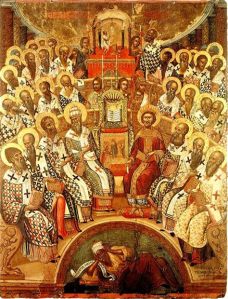
The Fathers of Nicea
Therefore, an antichrist is one who denies that Jesus is the Christ, that is, God in human flesh, and also one who denies the divine union of the Father and the Son which Jesus clearly proclaims in St John 10: 30, “I and the Father are one (ἐγὼ καὶ ὁ πατὴρ ἕν ἐσμεν).” The Nicene Creed defines this shared being of deity, this consubstantiality (ὁμοούσιον), which the Father and the Son both possess. I quote from the first few sentences of the Creed:
I believe in one God the Father Almighty creator of heaven and earth, of all things seen and unseen. And in one Lord Jesus Christ, the Only-begotten Son of God, begotten of the Father before all ages; Light of Light, true God of true God, begotten not created, of one essence (ὁμοούσιον) with the Father through whom all things were made.
Who, then, is the seventh century antichrist? Is it the so-called prophet of Islam, Muhammed? Perhaps, but the Islamic antichrist doctrine probably came from some other ancient source that predated the lifetime of Muhammad. Presented again is this defining and damning text from the Qur’an:
Say: He is Allah, the one and only; Allah, the eternal, absolute; he begets not, nor is he begotten; and there is none like unto him (Qur’an 112: 1 – 4).
By these four verses from the Qur’an, we see that Islam denies both the Son’s existence, and that of the Trinity. With these verses, there is the implied denial of the Incarnation. The defining criteria of antichrist are documented and applied to Islamic doctrine.
What, then, is the source of this passage? Again, it is unlikely that it comes from Muhammed himself, since western critical scholars of Islam conclude that Muhammed was theologically informed by a very limited Abrahamic monotheism. In his book Did Muhammad Exist, an Inquiry Into Islam’s Obscure Origins, (Revised ed., Nashville, Bombardier, 2021), Robert Spencer writes,
During the [years of early] conquest…the Islamic religion possessed only a rudimentary theology, which was probably even more basic among military units (p. 31).
Likely, their antichrist dogma comes from the early non-Nicene sects that were banished from Byzantine territories to Syria and Arabia. Among them were Arians, followers of the deposed bishop Arius who falsely taught that Jesus was a created being – not God in human flesh. Spencer writes about the Arians:
The Arians were by no means the first Christian group to view Christ as created. The Jewish-Christian Ebionites viewed Jesus as the Messiah but not in any sense divine…the Christian substratum of the Qur’an reflects a Christology that views Christ as a created being (p. 234).
Spencer continues,
As the Islamic faith began to develop as a distinct religion, it decisively rejected this faith in Christ and reinterpreted the Qur’an to fit its developing new theology (p. 236).
From another source, Exploring Islam, A Christian Perspective on the Life of Muhammad and the Qur’an, (Alhambra, CA, Sebastian Press, 2022), author Lawrence R Farley gives this insight:
The question of whether or not Muhammad was a true prophet depends upon one’s assessment of his handling of the stories and montheistic message he received from his Jewish and Christian sources. It is possible that his experience of listening to stories from Jews and Christians formed the matrix in which Allah spoke to him (p. 84).
The Qur’an’s “message” about Jesus Christ did not come from any true revelation, but was a simple reapplication of Arian and similar non-Nicene false Christologies, and thus, antichrist heresies.
The Apostolic teaching of St John
St John begins his first letter echoing the opening words of his Gospel’s first verses. But, he also expands on its words by establishing his apostolic authority. He declares that he was a witness of the Incarnate Word together with the other Apostles:
That which was from the beginning, which we heard, which we have seen with our eyes, which we observed, and our hands have touched concerning the Word of Life. The Life was manifested, and we have seen, and we testify, and we declare to you the Eternal Life, who was with the Father, and was manifested to us. That which we have see and have heard, we declare to you, in order that you also might have fellowship with us. And our fellowship is with the Father and with his Son Jesus Christ. And we write these things to you, in order that our joy might be made complete (1 St John 1: 1 – 4).
St John establishes that the Apostles saw, heard, and touched the Incarnate Word, the second Person of the Trinity who is the Only-begotten Son of God. He was no phantom or illusion that the antichrists of St John’s day taught about Christ.
The lies of any antichrist are contrary to the Apostolic faith, and inconsistent with Apostolic fellowship, the life of faith in the Church, and salvation given by the Triune God. Thus, St John gives us these words:
That which you heard from the beginning, let it abide in you. If that which you heard from the beginning should abide in you, you also abide in the Son and in the Father. And this is the promise which he declared to us, eternal life (1 St John 2: 24 – 25).

Light and Life
All of this was true in the days of St John, and all of this is equally true today for us alive in these troubling and dark days. The teachings of antichrists are all around us: Mormonism with its false prophet Joseph Smith, Jehovah’s Witnesses, Judaism, and of course Islam. Yet, there are antichrists found in academia, government, entertainment, and business – any and all who deny the Apostolic Faith. And, of course, one day there will be the final Antichrist who will deceive the nations. St John gives us more:
They are of the world, therefore what they say is of the world, and the world listens to them. We are of God. Whoever knows God listens to us, and he who is not of God does not listen to us. By this we know the spirit of truth and the spirit of error (1 St John 4: 5 – 6).
In Conclusion
This posting is to inform the faithful in Christ of our faith, and to make clear Islam’s doctrine regarding our Lord is of the spirit of antichrist. Although it is popular for the uninformed to object by saying, “But, we worship the same God!” Nothing could be further from the truth. Allah is a false god, and Muhammad, if he existed as Muslims insist, is a false prophet. Hence, Islam is a false religion – a religion of antichrist.
Let me state that we are not to bear ill will to our Muslim neighbors. Rather, it should be every Christian’s prayer that Muslims come to faith in God: Father, Son, and Holy Spirit — the One True God. And, thus, have the joy of fellowship with us who are of the One, Holy, Catholic, and Apostolic Faith.
In Christ who alone is the Way, the Truth, and the Life,
Fr Irenaeus
 Father Irenaeus Williams